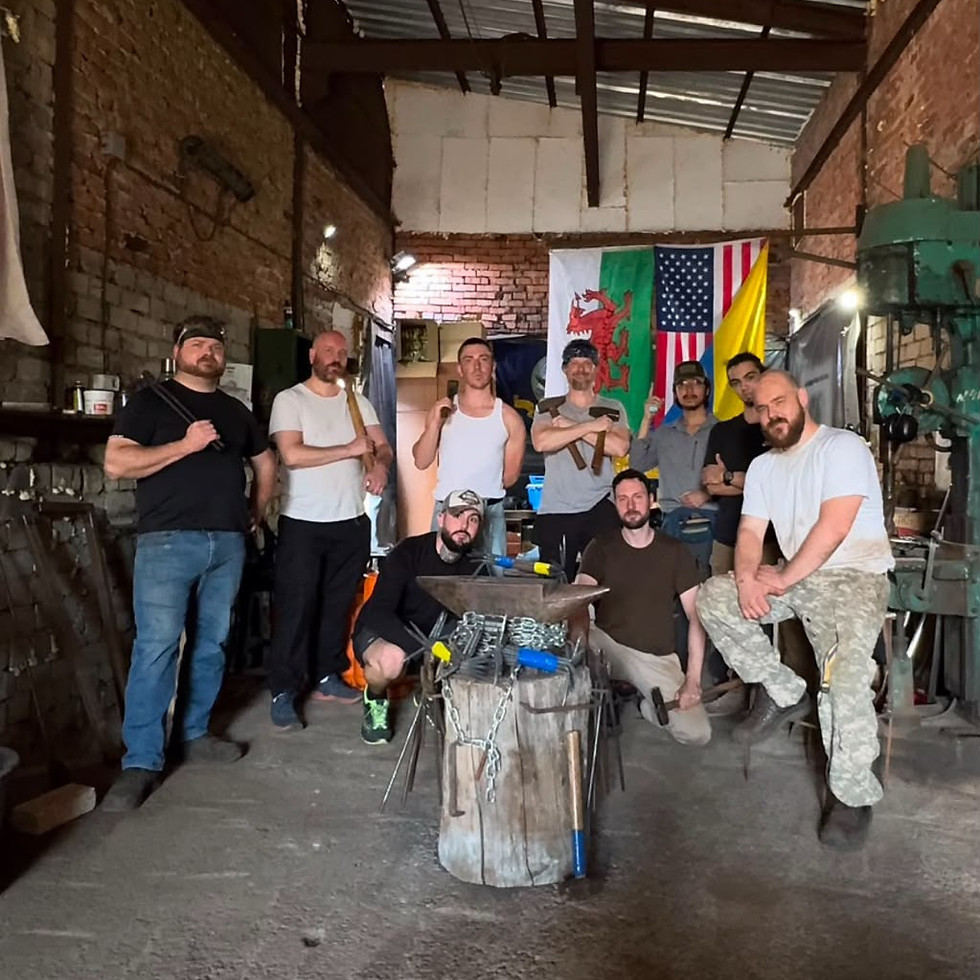
The Forging Ukraine
Initiative
Forging Ukraine began with a simple idea: if something is needed in Ukraine, and it can reasonably be made or sourced in Ukraine, then that should often be the first option. From a working forge in Kharkiv, that idea has developed into a nonprofit project combining blacksmithing, local manufacturing, volunteer labor, logistics, training, civilian support, and direct assistance to Ukrainian military personnel and partner organizations. Forging Ukraine does not attempt to replace larger aid organizations or solve every problem created by the war. Instead, its model is based on proximity, responsiveness, local knowledge, and practical output. By operating close to the people it supports, the organization can identify specific needs, respond quickly, receive direct feedback, and adapt its work without relying on long international supply chains or distant assumptions about what is useful.
The forge remains at the center of the project, but it is not the entire organization. What matters more is the role the workshop plays within a larger system of support. We manufacture equipment for Ukrainian soldiers and partner organizations, produce high-volume items, fabricate specialized hardware, modify equipment when a standard product does not solve the problem, assist with civilian evacuation vehicles, help move aid and materials, and train volunteers so they are capable of operating responsibly in Ukraine. The work changes depending on what is needed.
That flexibility is one of Forging Ukraine’s greatest strengths. Larger aid systems often have to operate through formal procurement chains, predetermined programs, and long approval processes. Those systems are necessary for work at scale, but they can struggle with small, unusual, or rapidly changing problems. Forging Ukraine occupies a different space. A soldier, volunteer, workshop, charity, or partner organization can approach us with a specific problem, and we can determine whether we have the tools, skills, labor, or relationships needed to help solve it. Sometimes that means designing something from scratch. Sometimes it means modifying a vehicle, moving supplies, finding materials, or connecting the right people. And sometimes the answer is far simpler: take a basic piece of steel that is needed constantly, make it well, make it in large numbers, and make it close to the people using it.
That is where trench staples come in.


Why Trench Staples
Trench staples are one of the simplest things we make, but they are also one of the clearest examples of why local production matters. These heavy pieces of forged steel are driven into timber to secure beams, reinforce trenches and dugouts, repair damaged positions, and rebuild structures after attacks. There is no complicated technology involved. A soldier needs a staple, a hammer, and something that needs to stay together.
What makes them important is scale. Forging Ukraine produces tens of thousands of trench staples every year because they are used constantly. Defensive positions are expanded, reinforced, damaged, repaired, and rebuilt, creating a continuous demand for simple hardware that can be put to work immediately.
That volume is also why producing them locally makes sense. Shipping a basic piece of forged steel across Europe is unnecessary when the material, equipment, labor, and knowledge needed to manufacture it are already available in Ukraine. Instead, we can turn steel into finished equipment close to the people who use it and move tens of thousands of useful pieces through a relatively small workshop every year.
Local production also gives us direct feedback. The people receiving our equipment can tell us what works, what does not, and what should change. If a staple needs to be longer, thicker, easier to drive, or produced differently, that information can come directly back to the forge and influence the next production run.
Quality matters at this scale. Making ten good staples is one thing; making tens of thousands consistently is another. A poorly forged staple can bend, crack, or fail to hold properly. Every piece needs to withstand repeated hammer blows, difficult weather, and the stress placed on the structures it helps secure. For that reason, we have spent significant time refining our process so that speed does not come at the expense of reliability.
This is not glamorous production. That is part of the point.
Trench staples are inexpensive, straightforward to manufacture, easy to distribute, and immediately useful. They do not require specialized training, complicated maintenance, or an instruction manual. They are simply pieces of steel that soldiers continue to need in enormous numbers.
We make them here, we make them properly, and we keep making them.
At the end of the day, Forging Ukraine is a charity built around doing practical work and doing it well. We take steel and turn it into equipment that gets used, we build and modify things when there is a problem worth solving, and we work alongside people across Ukraine who help make sure that effort goes somewhere useful. We are proud of what comes out of our forge, proud of how much a relatively small workshop can produce, and proud that the work has grown into something much larger than blacksmithing alone.
There is still a hell of a lot more we want to make, improve, and support. Steel, fuel, tools, vehicles, transportation, and everything else that keeps the work moving cost money, and that is where outside support makes a real difference. If you believe in what we are doing, a donation helps us keep the forge hot, the equipment moving, and the next project possible. We will keep making useful things for as long as people need them, and we would love to have you behind us while we do it.
Forging Ukraine has grown because there is a real demand for the work we do, and we want to keep building on that. Every donation helps pay for the steel, fuel, tools, repairs, transportation, and other costs that allow the project to keep moving. Support does not disappear into an abstract promise; it becomes something tangible, a finished piece of equipment, a repaired vehicle, a delivery completed, or another day of work in the forge. If you believe in what we are doing, your support helps us continue doing more of it, and doing it well.
Help Build What Comes Next